
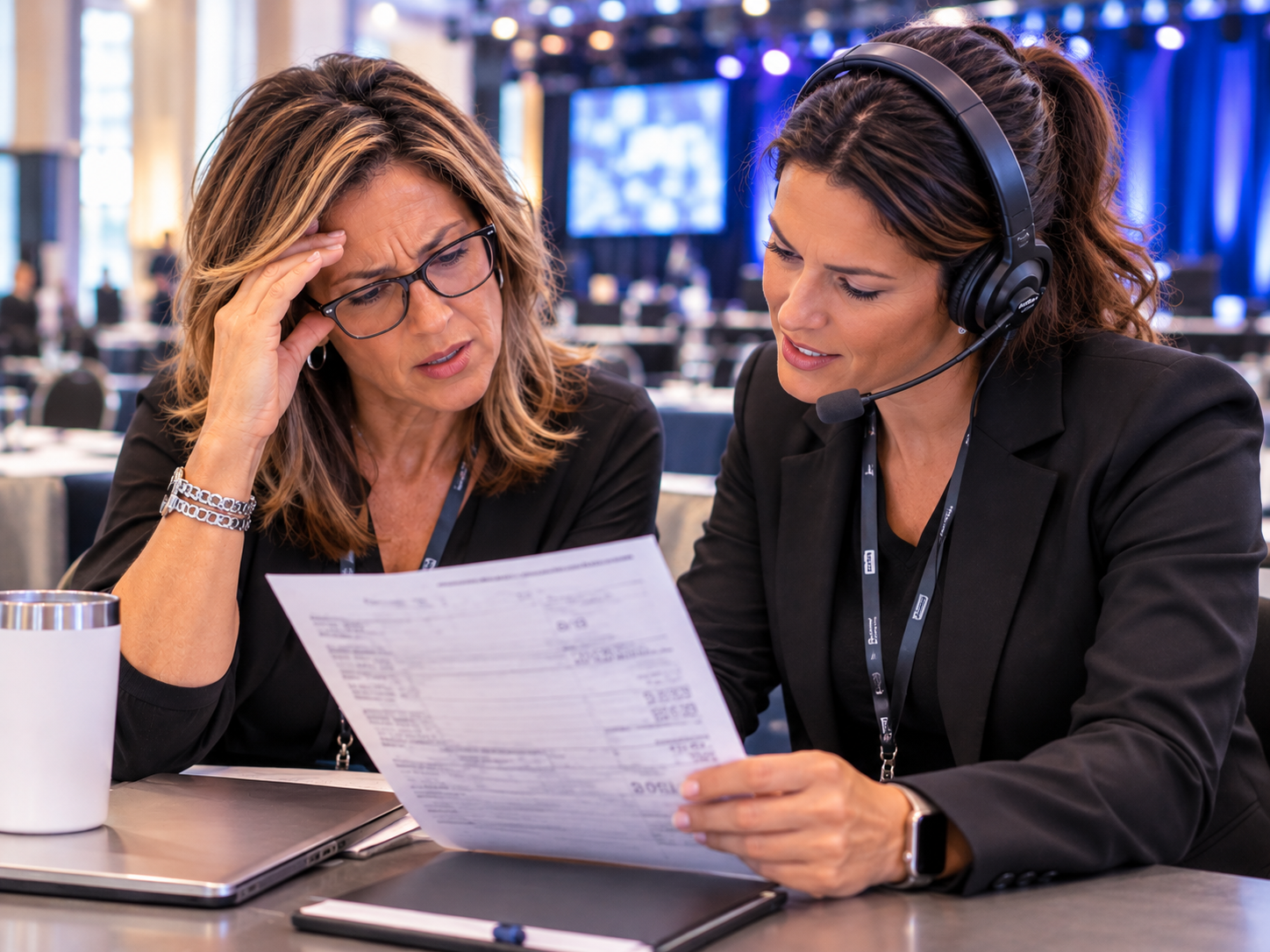
Understanding labor, travel days, change orders, and the final reconciliation.
After more than 26 years in the audiovisual production industry, I've learned that some of the most important conversations about an event happen long before the first piece of equipment arrives and sometimes after the last truck leaves.
One of those conversations is about the final invoice.
For experienced meeting planners, many aspects of production billing are familiar. For professionals entering the meetings and events industry, however, AV budgets can introduce an entirely different set of considerations. Without a clear understanding of how production costs are structured, even legitimate charges can lead to confusion, frustration and, ultimately, a loss of trust between planners and their production partners.
And that's understandable.
Unlike purchasing a product with a fixed price, producing a live event involves people, equipment, logistics, changing schedules, and countless decisions that can affect the final cost.
Understanding how those pieces fit together helps planners ask better questions, manage budgets more effectively, and build stronger relationships with their production partners.
1. An AV Quote Is a Plan, Not Just a Price
When an AV company develops a proposal, it is estimating the resources required to execute an event based on the information available at the time the quote is developed.
That includes equipment, technical personnel, preparation, transportation, setup, rehearsals, show execution, and dismantling.
We all know events evolve.
A rehearsal runs longer than anticipated. A presenter needs additional support. A room configuration changes. Equipment requirements are adjusted.
Some changes increase costs. Others create opportunities for savings.
The important distinction is understanding which elements of the proposal are fixed commitments, which are estimates, and how changes will be documented under the agreement.
A well-prepared AV proposal should explain not only what something costs but also how that cost may evolve.
2. Equipment Credits Are Part of Responsible Production Management
Here's something planners may not realize: an equipment list can change substantially between the initial proposal and show day.
As production plans become more refined, a technical team may determine that certain equipment is no longer necessary.
Perhaps a different signal-distribution approach eliminates a piece of gear. Maybe the final room design requires fewer monitors. Or perhaps the content strategy changes the equipment configuration.
When those decisions result in a credit under the agreement, the change should be documented.
This is precisely why change orders exist.
A change order isn't necessarily a request for more money. It can document additions, reductions, substitutions, or credits.
And an equipment credit doesn't automatically mean the original proposal was wrong.
It may simply mean the production team continued refining the plan and identified a more efficient way to deliver the experience.
The goal isn't to use everything originally proposed. It's to use what the event actually needs. A responsible production partner continually evaluates those needs and transparently documents any resulting adjustments or credits.
3. Labor Is Different from Equipment
This is one of the most important distinctions in production budgeting.
Equipment can often be counted in units. Labor is more dynamic.
A production estimate may anticipate a certain number of hours on-site for a technical director, camera operator, stage manager, or engineer.
But actual hours depend on what happens during preparation and on-site execution.
If a rehearsal extends, the technician supporting that rehearsal may work additional hours. If the venue requires a longer load-out, the crew may remain on the clock.
Conversely, if work is eliminated, the treatment of those hours depends on the agreement, whether the labor was already committed, and applicable cancellation or minimum-call provisions.
It's important to understand both sides of that equation.
If a contract allows adjustments based on actual labor incurred on-site, those adjustments may go up or down. A fair reconciliation considers the complete picture rather than examining only the hours that came in below estimate.
4. Why Am I Paying for a Travel Day?
This is a great question, especially for planners who are new to working with national production teams.
A travel day is not necessarily a day off.
When a specialized technician travels to an event, they are committing valuable time that cannot be booked for other projects.
They may spend much of the day in airports, traveling to a venue, or preparing for an early production call the following morning.
Even when an AV company has a local office, it may bring in specialized personnel from another market.
Why?
Because the right person for a particular role isn't always the closest person geographically.
This becomes especially relevant during peak event seasons, including spring and fall, when experienced production professionals can be booked months in advance.
Travel-day compensation is common in production; the amount and structure may vary. Some arrangements use a full-day rate, others a reduced rate, and some follow specific union or employment rules.
The key is to establish those expectations before the event.
5. Crew Minimums, Overtime, and Double Time Matter
Not every technician is billed under the same labor structure.
Depending on the location, venue, labor provider, union agreement, and individual contract, a crew member may have a minimum call of eight, ten, or more hours.
Overtime thresholds can also vary.
A technician might move into overtime after eight hours under one agreement and after ten under another. Double-time provisions may differ as well between twelve and fourteen hours.
There can also be additional costs associated with missed meal breaks, insufficient rest between shifts, or work performed during designated premium periods.
These aren't necessarily unexpected charges. They're often established labor conditions.
For planners, one of the best ways to control these costs is to review the production schedule early, particularly load-in, rehearsals, show times, and load-out. Coordinating crew meals and breaks with your production partner can also help avoid unnecessary labor extensions, meal penalties, and overtime. They are human and appreciate being fed and watered.
Sometimes adjusting the schedule by an hour can make a meaningful difference.
6. The Work You Don't See Still Has Value
When attendees enter a ballroom, they see the stage, screens, lighting, and presenters.
What they don't see is the work required to make everything appear effortless.
Production managers coordinate schedules and technical teams. Engineers review drawings and signal paths. Content specialists prepare media. Producers manage rehearsals, presenters, and the many decisions required to bring the program together.
This work may begin months before the event.
Some production companies include these services in a bundled fee. Others itemize them. Still others provide certain services as an added value.
None of those approaches is inherently better, provided the scope and pricing are clear.
What matters is understanding what is included and recognizing that preparation is part of production.
For a deeper look at the value of preparation, read our recently published article in Smart Meetings: The Work Behind the Wow: How Preproduction Protects Budgets, Timelines, and Attendee Experience.
7. A Final Reconciliation Should Tell the Whole Story
A final invoice should not be a mystery.
It should connect the original agreement with approved changes, applicable labor adjustments, credits, and other contractually billable costs.
That doesn't mean a planner shouldn't ask questions.
They absolutely should.
A good production partner should be prepared to explain charges, provide appropriate supporting documentation, and correct genuine errors.
Likewise, a productive reconciliation works best when both parties review the same contractual assumptions and consider additions and reductions consistently.
A credit is not necessarily evidence of an earlier mistake. An increase is not necessarily evidence of poor planning.
Both may be the result of decisions made as the event evolved. The objective is an accurate, understandable accounting of the services and resources provided.
8. Questions Every Meeting Planner Should Ask When Reviewing an AV Proposal
Whether you're producing your first conference or your fiftieth, set a time to review the proposal in detail. These questions can prevent confusion later:
Which charges are fixed and which are estimates?
How are actual labor hours tracked and reconciled?
What are the minimum calls, overtime thresholds, and double-time provisions?
Are travel days, per diem, lodging, and transportation included?
How are crew cancellations or schedule reductions handled?
Who can authorize changes to the production scope?
How will equipment reductions and credits be documented?
What is the process for reviewing and approving changes before additional costs are incurred?
What documentation will accompany the final invoice?
These aren't questions that signal distrust.
They're the questions that help establish shared expectations.
The AV = Added Value® Takeaway
Don't wait until you're ready to sign the contract to understand your AV proposal.
When your production partner first presents the proposal, schedule time to walk through it together. Understand what's included, what's fixed, what may change, and how those changes will be communicated, approved, and reconciled.
Ask questions early, revisit the details as your event evolves, and make sure everyone shares the same expectations well before signing the agreement.
Thirty minutes of conversation at the beginning can prevent hours of confusion at the end.
